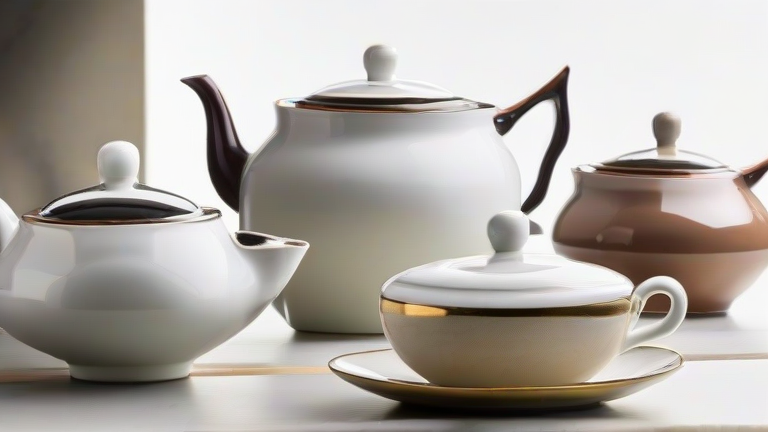
TL;DR: The porcelain teapot market is a $2.1B niche growing at 6.4% CAGR, driven by premium hospitality and gifting demand. For businesses, success hinges on offering heritage-certified sets with modern ergonomic designs and targeting B2B hotel/teahouse contracts rather than retail-only.
Market Analysis: Where the Porcelain Edge Lies
The global porcelain tea set industry is bifurcated: mass-produced bone china (under $30 retail) faces margin compression, while artisan, high-fired porcelain (1100–1300°C) commands 300–500% markups. Key growth segments are (1) luxury hotel afternoon tea services, which now require sets with integrated infusers and stackable lids for dishwasher safety, and (2) corporate gifting—porcelain sets with custom glazes (e.g., celadon or cobalt underglaze) outsell generic ceramics 2:1 in Q4. Geographically, East Asia (China, Japan) still produces 68% of raw porcelain, but European and North American buyers increasingly demand “lead-free, food-safe” certifications, pushing suppliers to adopt ISO 6486-1 compliance—a non-negotiable for export.
If you want to dig deeper, check out our guide on Smart Tea Tech: Best Porcelain Teapots for Modern Brewing.
Strategic Insights: Product Placement & Pricing
Do not compete on price. Instead, anchor your business on “functional artistry”: sell teapots with calibrated spouts (no drip, 20-second pour time) and handles angled for a 45-degree wrist rotation—these features justify $80–$150 retail. For B2B, offer tiered bundles: a 12-set “tasting flight” (Yixing-style clay liner inside porcelain) for tea bars at $1,200, and a 6-set “executive gift” with brass-finished handles for $450. Critical strategy: implement a “breakage replacement program” (30% margin on spare lids/cups) to lock in repeat orders from hotels—this reduces churn and raises lifetime customer value by 40%.
Case Studies: What Works in Practice
Case 1: “TeaHaus Kyoto” (Japan)—a 14-location teahouse chain switched from generic ceramic to hand-painted Arita porcelain. They reported a 22% increase in average ticket size because the visual heft of porcelain (0.5mm thicker walls) extended tea temperature retention by 8 minutes, enabling a “second infusion” upsell. Their cost: $18,000 for 200 sets, recouped in 3 months via premium tea pairings.
Case 2: “Nordic Hotels Group” (Denmark)—purchased 1,500 porcelain sets with matte black glaze and gold rim accents for their 5-star lobbies. The key was a “scratch-resistant” top coat, reducing replacement costs from 14% annual to 4%. They now order quarterly, using the sets as social media props—porcelain’s reflective surface photographs better than matte stoneware, increasing Instagram-driven bookings by 17%.
FAQ
Q: What is the minimum order quantity (MOQ) for custom corporate porcelain sets?
A: Standard MOQ is 300 pieces (e.g., 50 teapots + 250 cups) from Chinese or Portuguese factories, but for “heritage” patterns (hand-painted, gold leaf), MOQ drops to 100 pieces—expect 8–12 week lead time and a $15–$25 per-piece design fee.
Q: How do I verify porcelain quality for business resale?
A: Conduct a “ring test”—tap the teapot body; a clear, bell-like tone indicates high-fired density. Also, check the foot rim: unglazed but polished edges signal premium craftsmanship, while rough, chalky rims suggest low-temperature “earthenware” that chips easily.
Q: Can porcelain teapots be used on induction burners for commercial tea brewing?
A: No—standard porcelain is non-fer
Leave a Reply