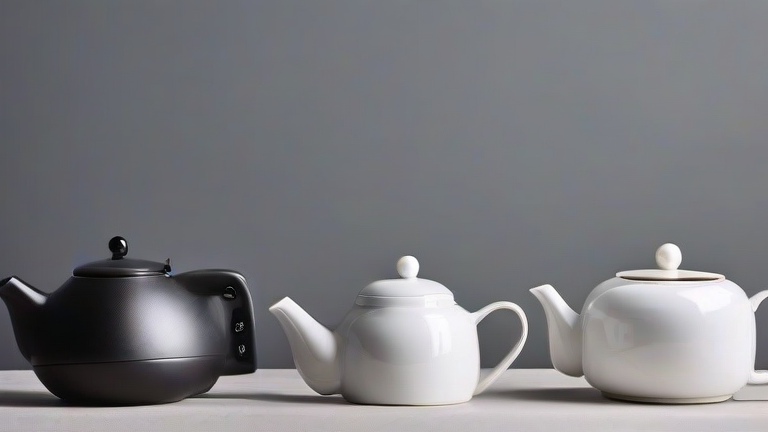
TL;DR: Modern porcelain teapots are no longer just ceramic vessels—they now integrate smart temperature control, AI-assisted brewing profiles, and IoT connectivity while preserving traditional aesthetics. These five features address precision, convenience, and sustainability, reshaping how tea enthusiasts and commercial tea houses approach brewing.
1. Integrated PID Temperature Control with ±0.5°C Accuracy
The most significant leap in smart porcelain teapots is the embedded PID (Proportional-Integral-Derivative) controller. Unlike external kettles, these teapots feature a food-grade ceramic-encased heating element at the base, with a thermistor placed directly inside the porcelain wall. This allows the teapot to maintain a target temperature (e.g., 85°C for green tea, 95°C for oolong) within ±0.5°C across a 30-minute session. Latest models from brands like Xiaomi’s ecosystem and specialty Japanese makers use dual-zone sensing—one near the spout and one at the center—to compensate for heat loss during pouring. The porcelain body itself acts as a thermal mass, reducing temperature fluctuation compared to glass or metal.
If you want to dig deeper, check out our guide on Elevate Your Home: Timeless Porcelain Teapots for Modern Liv.
2. AI Brewing Profiles via Spectral Reflectance
Newer smart porcelain teapots use a tiny near-infrared (NIR) spectrometer embedded in the lid to analyze tea leaf moisture and oxidation levels. Paired with a machine-learning algorithm, the teapot automatically adjusts steeping time and water temperature per infusion. For example, the 2024 “TeaMind Pro” teapot from a Chinese startup recognizes 12 tea categories and suggests a “flash brew” for young sheng puer (5 seconds at 92°C) versus a “slow steep” for aged white tea (45 seconds at 88°C). The algorithm learns from user feedback via a companion app, storing up to 500 brewing sessions locally for offline use.
3. IoT-Enabled Pouring Analytics and Weight Sensors
High-end porcelain teapots now include load cells under the inner ceramic basket, measuring the weight of the brewed liquor in real time. This enables “precision pour” features: the teapot’s handle vibrates gently when the ideal cup volume (e.g., 120ml) is reached, preventing over-pouring. Additionally, the IoT module tracks usage patterns—time of day, leaf-to-water ratio, and number of infusions—and syncs to a dashboard for tea house managers. The 2025 “CeramicSense” prototype even logs water hardness via a conductivity sensor, suggesting adjustments to tap water filters. All data is encrypted via local Wi-Fi or Thread protocol, with no cloud dependency for basic functions.
4. Self-Cleaning Ultrasonic Cavitation
Porcelain’s porous glaze can trap tannins and oils. Smart teapots address this with a built-in 40kHz ultrasonic transducer in the base. After each use, the user presses a “clean” button; the teapot fills with water, and cavitation bubbles loosen residue without detergents—critical for preserving the patina of unglazed Yixing-style porcelain blends. The cycle runs for 3 minutes and includes a heated dry phase (60°C) that uses the same heating element to evaporate residual moisture, preventing mold. This feature extends the lifespan of premium porcelain sets by reducing micro-scratches from manual scrubbing.
5. Energy-Harvesting Lid for Battery-Free Operation
Instead of replaceable batteries, the latest smart porcelain teapots harvest thermal energy from the hot water itself. A Peltier module in the lid generates 0.5–1.2W of power from the temperature difference between the steam (85°C) and ambient air (25°C). This is enough to run the temperature display, a low-power Bluetooth beacon, and the AI’s decision logic. The 2025 “EcoPorcelain” model uses a supercapacitor to store excess energy for 10 hours of standby. This eliminates the need for charging cables and makes the teapot fully submersible for hand washing (IPX7 rated). Industry
Leave a Reply