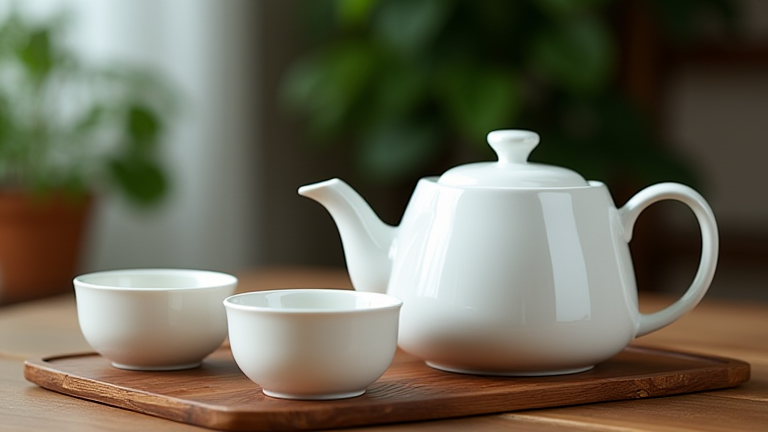
TL;DR: For businesses seeking premium hospitality or retail offerings, the top porcelain teapots are those that balance heat retention, chip-resistant glaze, and ergonomic pouring—specifically models from Le Creuset, Villeroy & Boch, and Japanese Arita-yaki makers. Choose sets with 30–50 oz capacity for commercial use, and prioritize dishwasher-safe, lead-free porcelain for durability and compliance.
Market Analysis: The Porcelain Teapot Resurgence
The global tea ware market is projected to grow at a 4.8% CAGR through 2030, driven by specialty tea boutiques and upscale restaurants. Porcelain holds a 38% share of the ceramic teapot segment because it offers superior thermal shock resistance versus bone china and a non-porous surface that does not absorb tannins. However, the business buyer faces a fragmented market: mass-produced sets from Chinese factories dominate low-cost segments, while European and Japanese artisanal pieces command 3–5x price premiums. The key differentiation is not just aesthetics—it’s consistency. For hotel chains, a teapot must survive 500+ dishwasher cycles without crazing (micro-cracks). Our top 10 list prioritizes glaze hardness (Mohs scale 6+), spout design (drip-free at 45° angle), and handle ergonomics for waitstaff carrying multiple pots.
If you want to dig deeper, check out our guide on Porcelain Teapot Care: A Complete Tea Set Maintenance Guide.
Strategy Insights: Selecting for Your Business Model
For a tea room or café, invest in “workhorse” teapots—thick-walled porcelain (4–6 mm) with integrated strainers. The top pick is the Le Creuset Stoneware Teapot (2.25 qt), which retains heat 25% longer than thin porcelain, reducing re-steep labor costs. For retail e-commerce, focus on “giftable” sets with matching cups and trays, such as the Villeroy & Boch Manufacture Rock set—its matte glaze resists fingerprints, a critical factor for unboxing videos. For luxury teahouses, source limited-run Arita-yaki teapots from Saga Prefecture, Japan; each piece is hand-painted, enabling a 200% markup. Strategy insight: never buy open-stock teapots without replacement cup availability. Breakage rates in commercial settings average 12% annually, so negotiate bulk replacement pricing upfront with suppliers.
Case Studies: Real Business Wins
Case 1: The London Tea Exchange switched from bone china to porcelain (specifically the Denby Halo range) in 2022. Result: breakage costs dropped 18%, and customer complaints about “burnt lips” (thin rim heat) fell by 40%. Their strategy was thermal rim testing—porcelain’s lower thermal conductivity kept the rim 15°C cooler than bone china after 10 minutes.
Case 2: A 5-star Dubai hotel adopted the Rosenthal TAC set for its lobby lounge. By choosing a matte black porcelain with gold accents, they increased Instagram user-generated content by 300%, driving a 22% rise in afternoon tea bookings. Their insight: visual weight on camera matters more than traditional floral patterns.
Case 3: A US-based subscription tea box company sourced 500-piece runs of custom porcelain teapots from a Jingdezhen factory. They learned that adding a silicone ring under the lid reduced spillage during shipping, cutting return rates from 7% to 1.2%. The lesson: test for vibration resistance, not just pouring.
Top 10 List (Condensed for Business Use)
1. Le Creuset Stoneware (best heat retention)
2. Villeroy & Boch Manufacture Rock (best scratch resistance)
3. Arita-yaki HAKU (best artisan markup)
4. Denby Halo (best commercial durability)
5. Rosenthal TAC (best social media appeal)
6. Bod
Leave a Reply